Market Insights
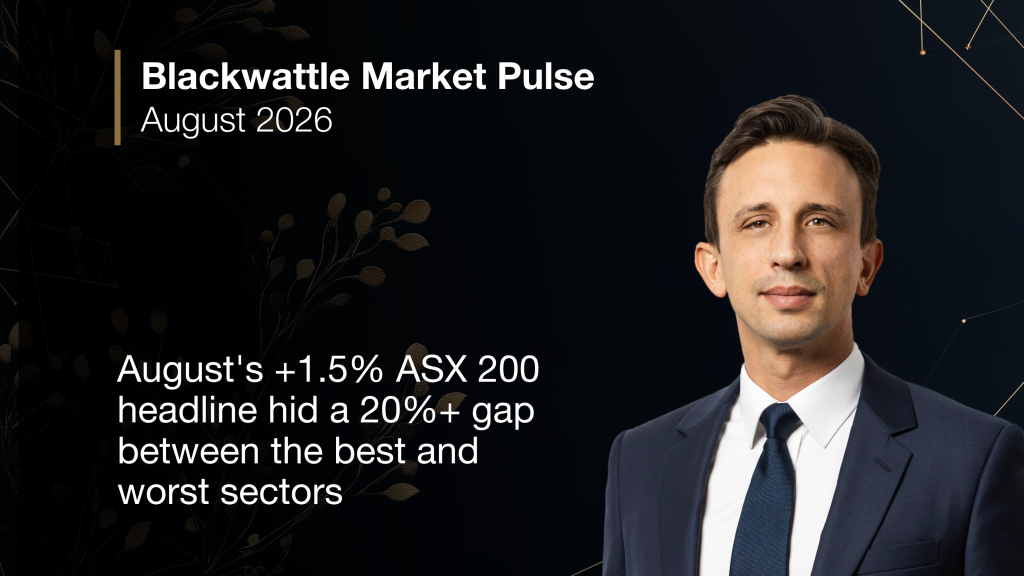
Australian equity markets rose again in August, with the S&P/ASX 200 returning +1.5% to bring year-to-date returns to +6.3%, a fifth consecutive month of gains.
The headline masked one of the sharpest months of dispersion in recent memory: the S&P/ASX 20 fell -0.63% while the MidCap 50 rose 5.5% and the Small Ordinaries returned +5.2%, as reporting season drove volatility.
The spread between the best and worst performing sectors exceeded 20%, an environment that, in our view, rewards disciplined bottom-up stock selection.
Domestically, the Reserve Bank of Australia left the cash rate unchanged at 4.35% at its 11 August meeting, its second consecutive hold, with Governor Bullock emphasising that inflation remains too high and that the Board now expects inflation to remain above the midpoint of the target band until mid-2027.
The July monthly CPI, released late in the month, showed headline inflation easing to +3.5% year-on-year from +3.8%, but this was hotter than the +3.3% expected, and the trimmed mean was unchanged at +3.6%.
Household spending grew +7.7% year-on-year, ahead of expectations, while the unemployment rate rose to 4.5%. Market pricing for further RBA hikes shifted from 0.5 to 1.1 hikes for 2026 over the month. The housing market continued to soften: national house prices fell a further -0.9% in August, and CBA noted that mortgage application volumes have fallen 15% since the Federal Budget, with investor mortgage applications down 28%.
Reporting season showed what a difference a year makes.
- Health Care was the strongest sector, returning +18.8% in August; a year ago it was by far the weakest, returning minus 13.2%, and even after last month’s rally the sector remains -18.0% over 12 months.
- Lowered expectations and compressed valuation multiples combined to produce outsized responses to results that were, if not better than expectations, at least ‘better than feared’. CSL (CSL) rose approximately +40% after its FY26 result reset earnings expectations.
- Consumer Discretionary saw the reverse dynamic, returning -7.9% as the weakest sector, with management teams citing a ‘battered consumer’ and JB Hi-Fi (JBH) delivering a sharp negative surprise on soft fourth quarter sales and weak early FY27 trading, dragging Wesfarmers (WES), Harvey Norman (HVN) and Super Retail Group (SUL) lower.
- Financials returned -5.4%, driven by the major banks: CBA -7.8%, NAB -6.5% and Westpac -8.8%, with ANZ the outlier at -0.3%, its much lower valuation multiple proving more defensible.
- Beneath the surface, size and factor leadership reversed sharply from July.
- Small Resources gained +17.5% in a broad-based rally, with gold stocks the clear standout, while Small Industrials were broadly unchanged at +0.2%.
- Momentum and Quality rebounded to lead factor returns, while Size and Beta lagged. In large caps, Growth was the strongest returning style.
- Commodity markets were dominated by gold, which rose +9.7% as the US dollar weakened, long-term bond yields rose on debasement and fiscal sustainability concerns, and central bank purchasing continued.
- Oil markets turned volatile again, with tanker attacks in the Strait of Hormuz reversing the June ceasefire optimism and returning Brent crude to around US$87 per barrel by month end, undermining the disinflation narrative.
- Copper prices continued to grind higher on data centre and electrification demand.
Globally, the S&P 500 gained +2.7% in August, its first monthly gain since May, led by a rebound in technology stocks after Nvidia reported 106% revenue growth.
The more consequential move, in our view, was in bond markets. US 30-year Treasury yields reached 5.33%, the highest since 2007, German 10-year Bund yields reached levels not seen since 2011, and Japan’s 10-year yield approached 3.0%. The US Treasury Secretary’s announcement of expanded long-bond purchases initially sparked a small rally in bonds that dissipated as inflation concerns grew, and new Federal Reserve Chair Kevin Warsh used his inaugural Jackson Hole speech to jawbone markets on higher rates, with inflation still running well above the 2% target.
The re-emergence of military strikes between the US and Iran late in the month added a further geopolitical premium.
The dispersion between winners and losers, across sectors, size cohorts and individual stocks, continues to widen. In our view, this reinforces the importance of disciplined active management and owning companies that can compound value irrespective of economic noise.
Outlook
As always, we premise our views with: We do not attempt to forecast markets, as we do not believe this possible. However,
we do apply stringent risk and macroeconomic overlays to our investments. We train ourselves to think long term and not be
distracted by short-term thinking or market fluctuations.
We believe that investors should focus on high-quality companies with resilient business models, strong balance sheets, and a
proven ability to navigate complex environments.
Domestically, the path of interest rates has become the central question for the year ahead. Stronger-than-expected household
spending and a hotter July CPI have renewed the risk of further RBA hikes; while the economy is being impacted by the Federal
Budget tax changes, falling house prices and sharply higher fuel costs.
Higher borrowing costs are already showing up in company results, offsetting gains in operating profit.
In our opinion, equity valuations have become a little more stretched even before considering these pressures, and recent share
price reactions in stocks such as CBA, alongside takeover interest in stocks such as Perpetual and Reliance Worldwide, are
reminders that valuations do matter, even if the market appears to disregard them for stretches of time.
The structural themes we are focused on for the period ahead:
- The trajectory of domestic and global interest rates, with long-term bond yields at multi-year or multi-decade highs
and further RBA hikes now priced in. - The Australian consumer and housing sector, as the lagged impact of rate rises and Federal Budget tax changes
flows through mortgage applications, house prices and retail spending. - Energy and geopolitics, with the ongoing Iran conflict pushing oil prices above US$100 per barrel feeding both
inflation and bond yields. - Gold and real assets, as fiscal sustainability and currency debasement concerns support safe-haven demand and
central bank purchasing. - Widening earnings dispersion, where constrained corporate outlooks are weighing on FY27+ expectations and
separating genuinely durable business models from the rest.
Our response to this environment is unchanged: we look for companies with strong balance sheets, enduring competitive
advantages, aligned management teams, and attractive valuation entry points. We believe these characteristics matter most
precisely when macro uncertainty is elevated.
Globally, resilient US earnings sit alongside heightened macro and geopolitical uncertainty and the most attractive bond yields
in over a decade competing for capital. Key risks to markets, in our view, include a further leg higher in global bond yields, an
escalation of the Middle East conflict and its impact on oil prices, and a sharper-than-expected deterioration in the Australian
consumer. We expect volatility to remain elevated, and we view this as an opportunity for patient, valuation-disciplined investors.
Commentary on Blackwattle’s Funds
We will make mistakes and missteps. But rather than hide from our mistakes, as an investment team we strive to learn from them. This is one of our unwavering commitments.
This month, five of our Funds outperformed their respective benchmarks.
Small Cap Quality Fund click here
Small Cap Long-Short Quality Fund click here
Mid Cap Quality Fund click here
Large Cap Quality Fund click here
Long-Short 130/30 Quality Fund click here
Equity Income Fund click here

1: The Blackwattle Mid Cap Quality Fund, Large Cap Quality Fund, and Long-Short 130/30 Quality Fund’s inception dates are 8 August 2023. The Blackwattle Small Cap Quality Fund’s inception date is 12 September 2023. The Blackwattle Small Cap Long-Short Quality Fund’s inception date is 21 November 2023. Blackwattle Equity Income Fund inception date is 12 February 2026. 2. Small Cap Long-Short Quality Fund Returns are normalised for the removal of unallotted applications, following the transition of Investment Manager of the Fund. There was a six-month transition period beginning 21 November 2023 and ending 21 May 2024, following the transition of Investment Manager of the Fund. During this transition period, the Fund Benchmark was 50% cash rate as determined by the Reserve Bank of Australia and 50% S&P/ASX Small Ordinaries Accumulation Index 3. Benchmark: Long-Short 130/30 Quality Fund and Large Cap Quality Fund is S&P/ASX 200 Accumulation Index, Mid Cap Quality Fund is S&P/ASX300 Accumulation Index-S&P/ASX20 Accumulation Index, Small Cap and Small Cap Long-Short Quality Fund is Small Ordinaries Accumulation Index, Equity Income Fund is S&P/ASX 100 Total Return Index: 75% / RBA Cash Rate: 25%. All returns are calculated after fees have been deducted and assume distributions have been reinvested. No allowance is made for tax when calculating these figures. Past performance is not a reliable indicator of future performance. Source: Apex.
Blackwattle Large Cap Quality Fund
The fund returned +1.44%, underperforming the benchmark by 0.11% net of fees.
Key Contributors: the Financials sector was the largest contributor to alpha, driven by an underweight position in the major banks, particularly Commonwealth Bank (CBA), which ended the month down -7.8% after dividends. CBA’s FY26 result was sound, with revenue growth of 6.2% and profit growth of 7.1%, but when trading on the highest major bank P/E ratio in the world, valuation has become a key focus.
Asta Energy (1AST.DE) rose 14.6% on strong operational performance and an earnings upgrade for calendar 2026, with 1H26 net sales up +22.2% and normalised EBITDA up +54.2% as the company books out production capacity on data centre and electric vehicle demand. Reliance Worldwide (RWC) also contributed after receiving a takeover proposal from Brookfield Asset Management at $4.75, a 32% premium to the prior share price.
Key Detractors: the underweight in CSL (CSL) was the largest detractor. The Fund held a long position earlier this year but exited as the rising share price reached our valuation targets; the stock then re-rated to about 20x P/E on a ‘better-than-feared’ FY26 result, arguably fully priced given a still low growth outlook and peer Grifols trading at around 12x. Life360 (360), in which the Fund holds a long position, also detracted as the market sold the stock down on minor details despite a 2Q result showing 16% growth in Monthly Active Users, 27% growth in Global Paying Circles and 315% growth in Advertising. These reasons are, in our view, nitpicking in an otherwise sound set of results.
Blackwattle Long-Short 130/30 Quality Fund
The fund returned +1.50%, underperforming the benchmark by 0.04% net of fees.
Key Contributors: as with the Large Cap strategy, the underweight in the major banks, particularly Commonwealth Bank (CBA), was the largest contributor to alpha, followed by Asta Energy (1AST.DE), up 14.6% on an earnings upgrade, and Reliance Worldwide (RWC), which received a takeover proposal from Brookfield Asset Management at a 32% premium. The short book made a marginally positive contribution, with alpha generated from names in the IT and Industrials sectors.
Key Detractors: the underweight in CSL (CSL) was the largest detractor as the stock re-rated on a ‘better-than-feared’ FY26 result, and the long position in Life360 (360) detracted as the market focused on slightly lower 3Q EBITDA margin guidance rather than the strength of the underlying result.
Blackwattle Mid Cap Quality Fund
The fund returned +8.27%, outperforming the benchmark by 2.85% net of fees.
Key Contributors: Newmont Corporation (NEM) rallied 31% on stronger gold prices and the resolution of its North American JV dispute with Barrick, under which the Fourmile gold discovery, one of the most exciting in recent times, was vended into the JV for less than US$2b, well below valuation estimates of almost US$20b at spot gold prices. We view NEM as the highest quality gold miner globally and continue to see material upside as an ‘enduring high-quality’ business.
Key Detractors: Life360 (360) fell 21% as the market fretted about more constrained 3Q margin guidance on re-investment, despite a strong 2Q result and maintained full year guidance. We continue to see material upside for 360 as an ‘Improving Quality’ business, with its freemium model underpinning low-cost user acquisition, powerful network effects and significant monetisation optionality.
Pleasingly, the majority of portfolio companies delivered strong FY26 results, with non-Resources holdings such as Car Group (CAR), Guzman Y Gomez (GYG) and Light & Wonder (LNW) delivering robust results and positive outlooks. The portfolio remains balanced between three cohorts of quality: growth, cyclical and defensive businesses.
Blackwattle Small Cap Quality Fund
The fund returned +7.46%, outperforming the benchmark by 2.28% net of fees.
Key Contributors: Rox Resources (RXL) rose +53.3% as a site visit and positive operational update at the Diggers and Dealers conference confirmed the Youanmi gold project remains on schedule for first gold by mid-2027, adding to momentum from a rising gold price. Bapcor (BAP) rose +54.6% as its FY26 result demonstrated improving sales momentum, market share gains and stabilising earnings under new management. We established our position following a near 80% decline in the company’s market cap, on the basis that Bapcor retained valuable competitive advantages and the key missing ingredient was backable management with a clear strategy. These are now in place.
Key Detractors: Aussie Broadband (ABB) fell -9.4% despite a solid FY26 result with EPS growth of 26% and a $115m buyback, as the market focused on softness in gross margins rather than the operating leverage being generated through scale. The stock now trades at its cheapest valuation since listing, at just 13x P/E despite an above-peer growth profile, and we expect EPS growth of more than 25% over the next two years.
Performance was supported by diversification, with Resources the standout: the fund benefited from exposure to gold and future-facing materials including lithium, copper and uranium.
Blackwattle Small Cap Long-Short Quality Fund
The fund returned +9.62%, outperforming the benchmark by 4.44% net of fees.
Key Contributors: as with the Small Cap Quality Fund, Rox Resources (RXL), up +53.3% on continued progress at the Youanmi gold project, and Bapcor (BAP), up +54.6% as its turnaround gains traction under new management, were the key contributors.
Key Detractors: Aussie Broadband (ABB) fell -9.4% despite a solid FY26 result, as the market focused on gross margin softness rather than the company’s significant operating leverage. We remain attracted to the valuation at just 13x P/E.
Reporting season provided a valuable opportunity to meet with management teams across the portfolio and companies we are considering for future investment. Volatility was again evident throughout the season, and we were pleased with both the actions taken and the way the portfolio was positioned to manage it.
Blackwattle Equity Income Fund
The fund returned +0.85%, underperforming its reference index by 0.16% net of fees, representing a 70% capture of the S&P/ASX 100 Total Return Index return of +1.22%. This outcome is consistent with the lower volatility objective of the strategy, which is expected to lag in rising markets and provide a cushion in falling markets.
Key Contributors: Ramsay Health Care (RHC) benefitted from a strong FY26 result that delivered an EBIT beat driven by the UK and Sante operations, with constructive commentary on FY27 margin expansion. Holdings in Newmont Corporation (NEM) and Capricorn Metals (CMM) contributed as gold prices rallied strongly, Xero (XRO) extended its share price momentum, and significant underweight positions in Wesfarmers (WES) and Commonwealth Bank (CBA) both added to relative performance.
Key Detractors: the underweight in CSL (CSL) was the largest single detractor, with the stock rising approximately +40% following its FY26 result; the stabilisation of the core immunoglobulin business and closure of the troubled Vifor acquisition provided the catalyst to increase the holding at a valuation multiple that remains historically low. Goodman Group (GMG) was weak despite a strong operational beat, and the contribution from options was negative as sold call options limited participation in sharp gains across held names. The offset is that the option premium earned provides a valuable cushion in periods where the market weakens.
A new position in Life360 (360) was established during August, and the Fund ended the month invested in 33 stocks with 54 option positions covering 50% of portfolio value. Implied volatilities remain elevated, permitting the Fund to generate an attractive level of income.
Gratitude and Commitment
To our clients and partners – Thank you.
It is a privilege to represent your capital and hold your trust. We remain committed to investing alongside you, ensuring our interests are always aligned with your own. We re-iterate the commitments to our investors:
- We will always commit our own capital alongside your own.
- We will never allow personal trading.
- We will always constrain the capacity of our Funds.
- We will learn and improve from our mistakes.
- We will act with transparency.
Kind regards,
Michael Skinner CIO and Managing Director, and the entire Blackwattle Team
To download the full version, please click the link below: